Accelerating Innovation: The Power of Rapid Validation and High-Fidelity Prototyping
In today’s fast-paced digital landscape, speed to market is critical. But rushing a product to launch without proper validation can be a costly mistake. That’s where the dynamic duo of Rapid Validation and High-Fidelity Prototyping comes in. This powerful combination allows you to test ideas quickly, gather crucial feedback early, and refine your product vision before investing significant time and resources into full-scale development.
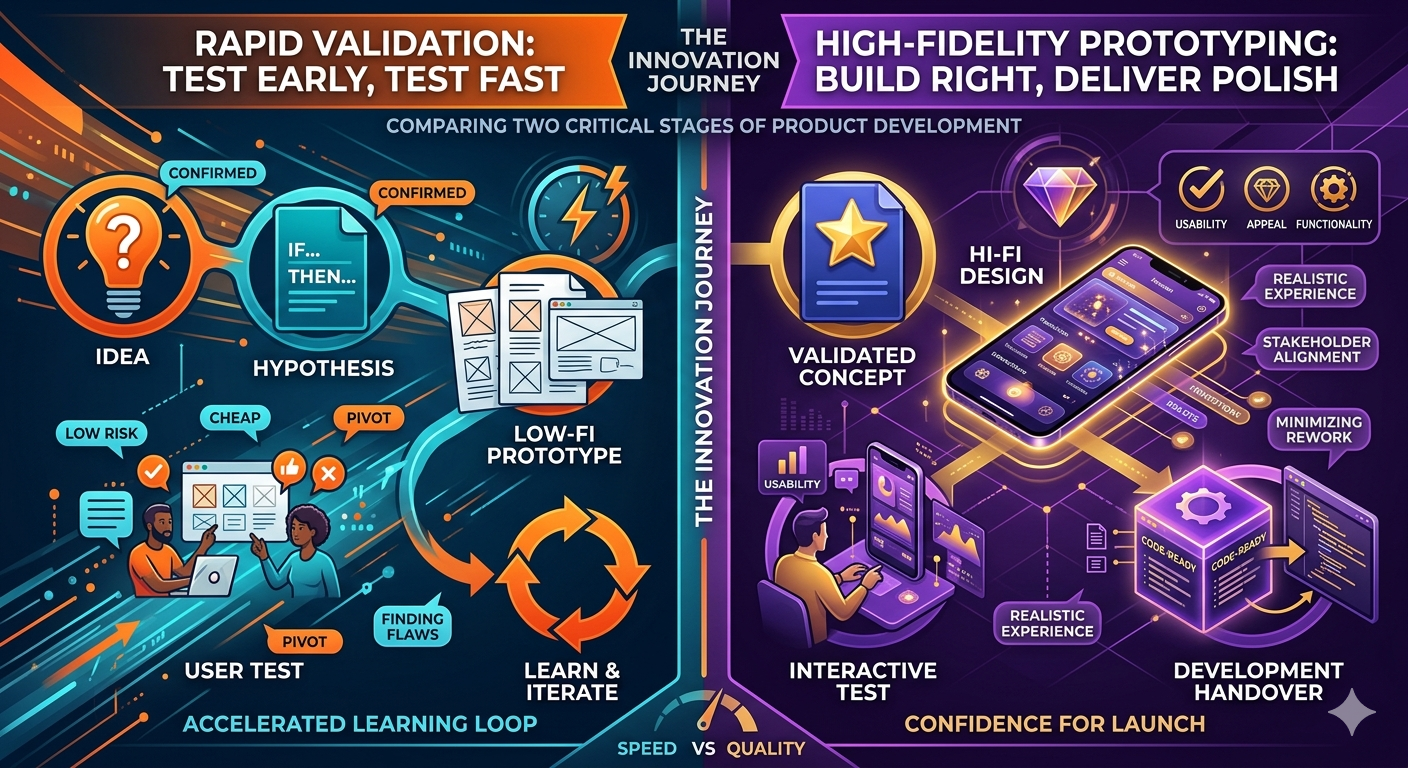
The image above perfectly encapsulates this iterative and accelerated approach to innovation. It visualizes the shift from the traditional, linear development model (left side) to a more agile, feedback-driven process (right side) powered by digital tools and rapid iteration.
Rapid Validation: Testing the Waters Before You Dive In
Rapid validation is all about quickly and efficiently testing the core assumptions underlying your product idea. Instead of building a complete product, you create low-fidelity prototypes—think sketches, wireframes, or basic interactive mockups—and get them in front of target users as fast as possible.
The left side of our image, “TRADITIONAL DEVELOPMENT – BEFORE,” illustrates the challenges of the old way. It shows a disjointed process with separate stages for ideation, design, and development, often leading to “Development Silos.” Feedback loops are slow and cumbersome, meaning critical insights often arrive too late in the process, increasing risk and potential for wasted effort.
Key benefits of rapid validation include:
Reduced Risk: Identify flawed assumptions early on, preventing you from building features nobody wants or needs.
Faster Iteration: Quickly test multiple concepts and variations, allowing you to narrow down the best solution.
Informed Decision-Making: Gather real-user data to guide your product roadmap and prioritize features.
Cost Savings: Avoid the high cost of reworking or scrapping fully developed features.
High-Fidelity Prototyping: Bringing Your Vision to Life
Once you’ve validated your core concept and gathered initial feedback, it’s time to elevate your prototype with high-fidelity design. High-fidelity prototypes are realistic, interactive representations of the final product, complete with visual design elements, interactions, and realistic data. They look and feel much more like the real thing, allowing for deeper and more meaningful user testing.
The right side of our image, “MODERN ITERATIVE PROCESS – AFTER,” showcases the power of high-fidelity prototyping within a digital, collaborative environment. Notice how all elements—from user testing to development—are centered around a “DIGITAL PROTOTYPE CORE.” This central hub enables seamless communication and continuous feedback loops.
High-fidelity prototyping offers significant advantages:
Realistic User Feedback: Users can interact with a near-final product experience, providing more accurate insights into usability and appeal.
Improved Stakeholder Alignment: Get buy-in from stakeholders by demonstrating a clear and compelling vision of the final product.
Streamlined Development Handover: Provide developers with a detailed and interactive spec, reducing ambiguity and accelerating development.
Early Marketing & Sales Validation: Use high-fidelity prototypes to create demos, pitch decks, and pre-launch marketing materials.
The Winning Combination: Speed and Quality
The true magic happens when you combine rapid validation with high-fidelity prototyping. Rapid validation helps you find the right product idea quickly, while high-fidelity prototyping ensures you build that product right. This symbiotic relationship allows you to innovate faster, reduce development risk, and ultimately deliver products that resonate deeply with your target audience.
By embracing this modern iterative approach, you move away from the slow, siloed processes of the past and towards a dynamic ecosystem where ideas are quickly tested, refined, and brought to life in a way that maximizes both speed and quality. Don’t just build faster—build smarter with rapid validation and high-fidelity prototyping.