The Digital Overhaul: Powering B2B Operations with Mobile Solutions
For decades, business-to-business (B2B) operations have often been synonymous with complex, legacy workflows. Think stacks of paperwork, slow data transfer between siloed systems, and a reactive approach to problem-solving. But the tide is turning. A new era of digital transformation is here, and it’s powered by modern B2B mobile solutions.
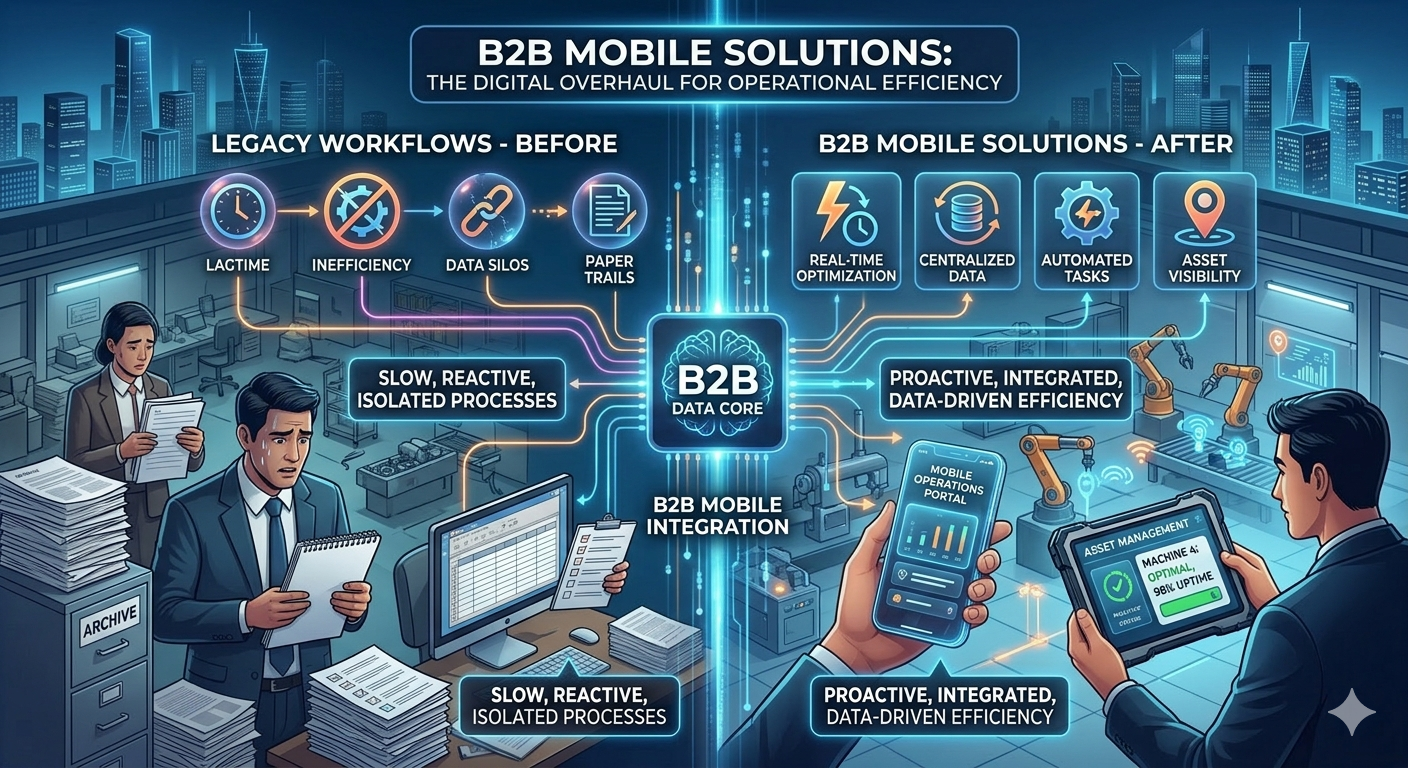
The image provided beautifully illustrates this fundamental shift. On the left, we see the traditional, “Legacy Workflows – Before” scenario. It’s a world of paper trails, data silos, and a frantic race to catch up with issues (reactive). On the right, “B2B Mobile Solutions – After,” we see a vision of a streamlined, efficient, and proactive future. This side is defined by real-time data, automated tasks, and a clear, unified view of assets and operations (proactive, integrated, data-driven).
The Benefits: What B2B Mobile Solutions Deliver
Modernizing your B2B operations with mobile solutions isn’t just about adopting new technology; it’s about unlocking a fundamental transformation in how you work.
Dramatic Efficiency Boost: By eliminating paper processes and automating mundane tasks, your teams can accomplish more in less time.
Real-Time Data Access: Imagine making decisions based on now, not yesterday. Mobile solutions provide instant access to crucial operational data, empowering your team to act decisively.
Break Down Data Silos: Mobile apps act as a unifying layer, seamlessly connecting different backend systems and ensuring data flows where it’s needed, not just where it’s stored.
A “Proactive” Posture: No more waiting for things to go wrong. Mobile-driven insights allow you to anticipate needs, schedule preventive maintenance, and optimize resources before a crisis hits.
Enhanced Visibility: Gain a complete, transparent view of your entire operational landscape, from the status of assets to the progress of workflows.
The Advantages: Why These Solutions are Essential
Beyond the immediate operational improvements, B2B mobile solutions offer distinct, long-term strategic advantages that are critical for success in today’s fast-paced market.
Competitive Edge: Companies that operate with greater efficiency and agility naturally have a significant advantage over their less-modernized competitors.
Improved Decision Making: With a wealth of accurate, real-time data at their fingertips, leaders at all levels can make faster, better-informed strategic and operational choices.
Happier, More Productive Workforce: Mobile solutions empower employees with better tools, reduced busywork, and more meaningful tasks, leading to higher morale and productivity.
Scalability for Growth: These solutions are designed to grow with you. As your business expands, your digital infrastructure can scale effortlessly to meet new challenges.
Future-Proofing: Embracing mobile technology today ensures your business is built on a modern, flexible foundation, ready to adapt to whatever new innovations the future may bring.
Critical Technical Strategies for Field-Ready Solutions
The “Invisible” Security Layer: Discussion on how B2B mobile platforms transition from vulnerable physical paperwork to encrypted, role-based access control and remote-wipe capabilities for sensitive corporate data.
Legacy System Interoperability: A look at how modern mobile middleware acts as a “translator” between 20-year-old ERP software and modern handheld devices, extending the life of existing infrastructure.
Offline-First Architecture: The critical importance of “Conflict Resolution” logic, allowing field workers to remain productive in remote areas (warehouses, basements, or rural sites) with seamless data syncing once reconnected.
Granular Performance Telemetry: Moving beyond high-level KPIs to track micro-efficiencies, such as identifying specific bottlenecks in a supply chain or measuring the exact “time-to-completion” for field service tickets.
User-Centric Design for the Industrial Workforce: Why B2B UX differs from consumer apps—focusing on high-contrast interfaces for outdoor use, glove-friendly touch targets, and voice-to-text for hands-free operations.
Predictive Maintenance Integration: How mobile solutions serve as the primary interface for IoT sensors, alerting technicians to machine failures before they occur to minimize “zero-hour” downtime.