The AI Toolkit: Navigating the Digital Overhaul Across 5 Key Categories
The “AI Revolution” is no longer a future concept—it is the current engine driving business efficiency and creative innovation. From generating complex code to crafting hyper-personalized marketing copy, AI tools have moved from being “cool toys” to essential components of a modern workflow.
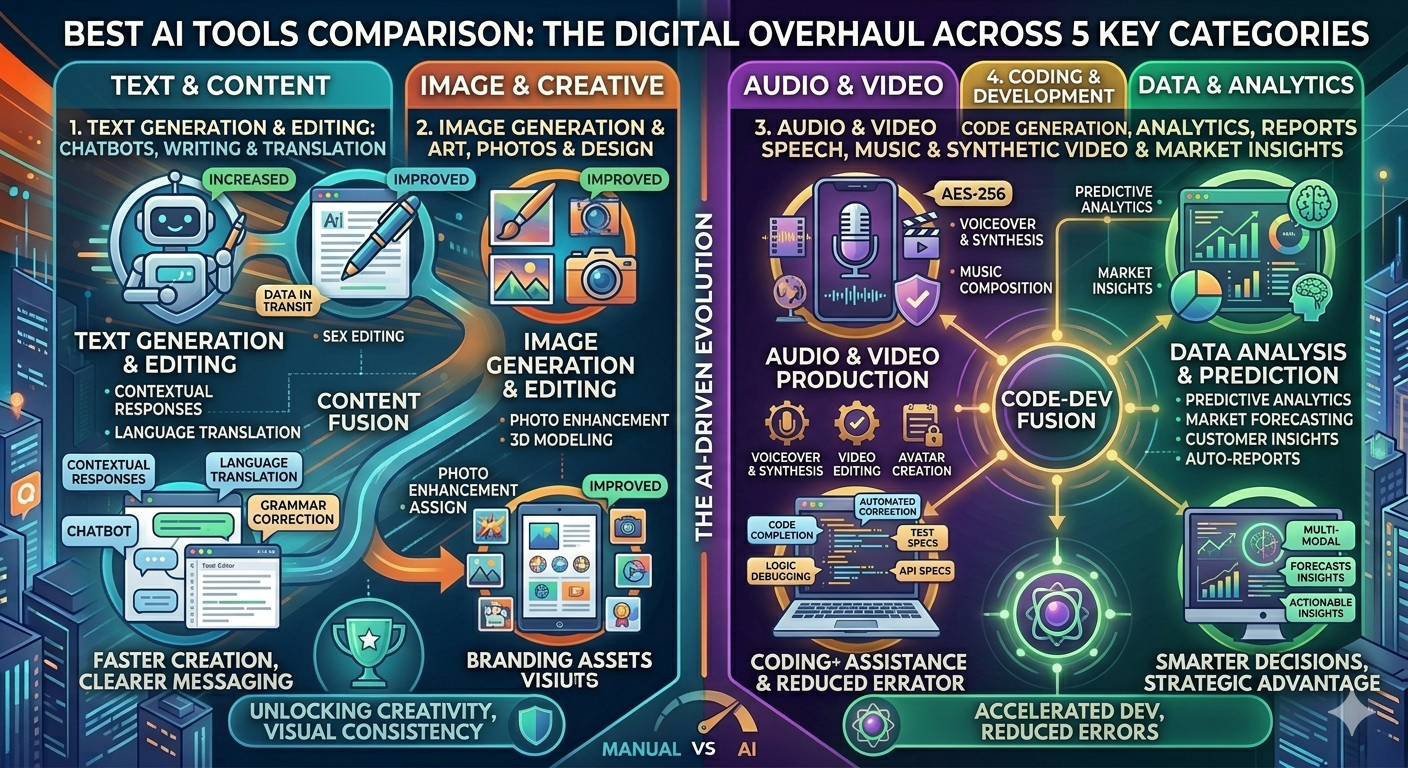
The infographic, “BEST AI TOOLS COMPARISON: THE DIGITAL OVERHAUL,” provides a comprehensive map of this landscape. It categorizes the AI explosion into five critical domains, helping you identify which tools will deliver the most strategic advantage for your specific needs.
1. Text & Content: The Communication Powerhouse
This category focuses on Text Generation & Editing. Tools in this space (like Gemini, ChatGPT, and specialized copy editors) are designed for:
Contextual Responses: Moving beyond simple search to providing nuanced, conversational answers.
Language Translation & Grammar: Real-time correction and localization that maintains tone and intent.
Content Fusion: Taking raw data and “fusing” it into compelling blog posts, emails, or reports.
The Result: Faster creation and clearer messaging that resonates with your audience.
2. Image & Creative: Visualizing the Vision
AI has democratized high-end design through Image Generation & Editing. This domain allows for:
Branding Assets: Creating logos, social media graphics, and marketing visuals in seconds.
Photo Enhancement: Using AI to upscale low-resolution images or remove unwanted backgrounds effortlessly.
3D Modeling & Art: Generating complex creative assets that previously required hours of manual labor.
The Result: Unlocking creativity while maintaining visual consistency across your brand.
3. Audio & Video: The Multimedia Frontier
The most dynamic growth is happening in Audio & Video Production. These tools enable:
Voiceover & Synthesis: Generating realistic, human-like narration in multiple languages without a recording studio.
Synthetic Video & Avatars: Creating professional video content using AI-generated presenters.
Music Composition: Producing original, royalty-free tracks tailored to the mood of your project.
The Result: High-fidelity multimedia production at a fraction of the traditional cost.
4. Coding & Development: Building Smarter, Faster
For technical teams, Coding Assistance is a game-changer. By using AI “Co-pilots,” developers can achieve:
Code Completion & Debugging: AI suggests the next lines of code and identifies logic errors in real-time.
API & Test Specs: Automatically generating documentation and testing protocols.
Logic Verification: Ensuring that the “clean code” principles we discussed earlier are maintained.
The Result: Accelerated development cycles and a massive reduction in human error.
5. Data & Analytics: From Information to Insight
The final pillar is Data Analysis & Prediction. This is where AI turns raw numbers into a strategic roadmap:
Predictive Analytics: Forecasting market trends and customer behavior before they happen.
Market Insights: Analyzing vast amounts of competitor data to find “gaps” in the market.
Auto-Reporting: Converting complex data sets into actionable, easy-to-read executive summaries.
The Result: Smarter decisions and a sustainable strategic advantage.
Conclusion: Moving from Manual to AI-Driven
As the “Manual vs. AI” gauge in our infographic shows, the shift toward AI-driven workflows is accelerating. By integrating the right tools across these five categories, you aren’t just keeping up—you are leading the digital evolution.
Whether you are looking to secure your website, improve your AEO visibility, or overhaul your B2B operations, there is an AI tool designed to act as your force multiplier.