The Digital Evolution: SEO vs. ARO Marketing – Choose Your Strategic Path
The digital marketing landscape is not static; it is a continuously evolving battlefield for visibility and audience attention. For years, Search Engine Optimization (SEO) has been the reigning champion, the defined playbook for conquering search results. But we are now witnessing a fundamental shift—a transformation driven by artificial intelligence, conversational interfaces, and the rise of Answer Engines. This evolution demands a new strategy: Algorithmic Relevance Optimization (ARO).
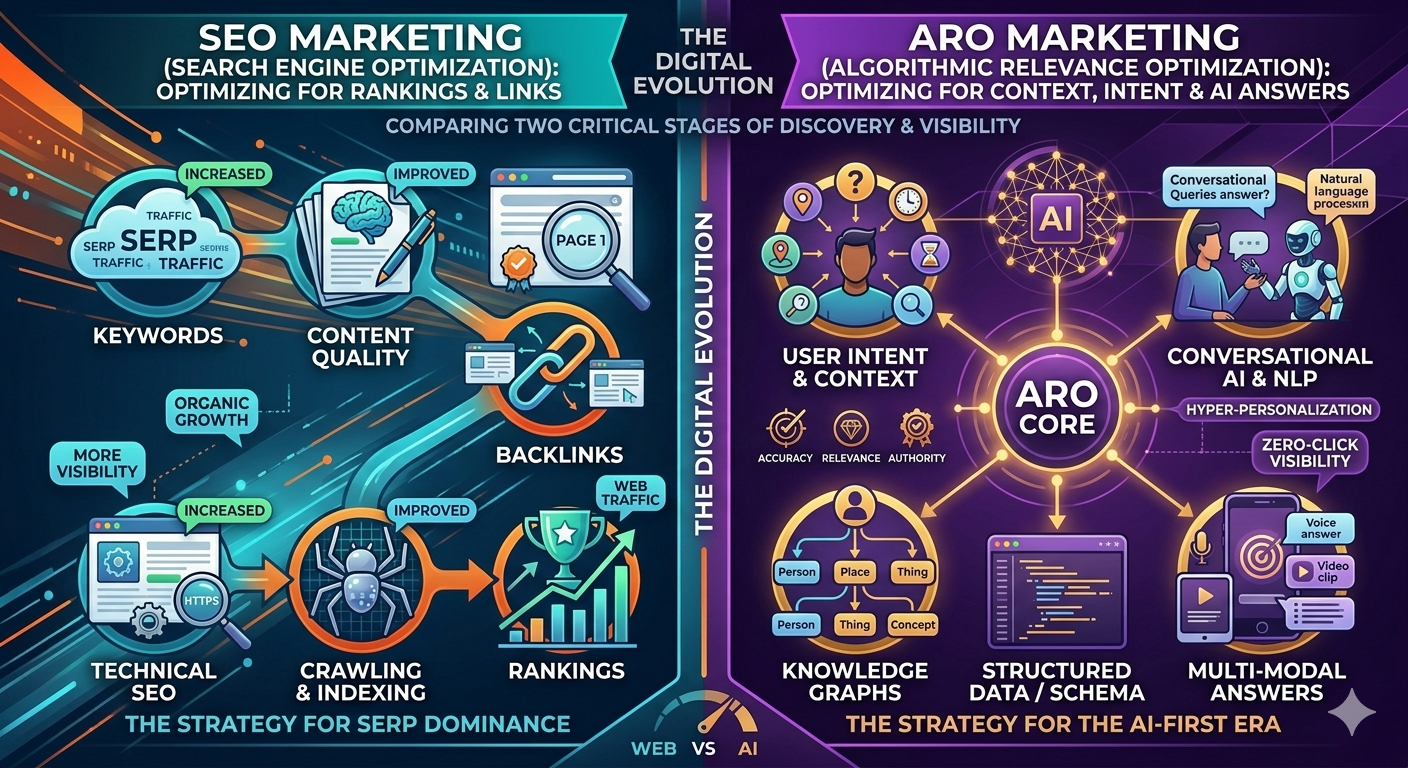
The infographic provided perfectly visualizes this moment of transition. It juxtaposes the established, linear foundation of SEO with the emerging, network-centric model of ARO. It doesn’t present ARO as a simple replacement, but rather as the essential “next level” for brands that want to remain relevant and visible in an AI-first world.
Let’s dissect this digital evolution to understand the core differences, strategic priorities, and how you can position your brand for future dominance.
Part 1: The Legacy of SERP Dominance – Understanding SEO Marketing
SEO is the cornerstone of traditional web visibility. As the infographic details, its primary objective is “Optimizing for Rankings & Links.” This is achieved through a structured, often linear process focused on three main pillars: technical health, content quality, and external validation.
The Pillars of the SEO Strategy:
Technical SEO: This is the unseen foundation. It involves ensuring your website is technically sound—that it loads quickly, is mobile-friendly (HTTPS), is free of crawl errors, and has a clear XML sitemap for search engines to easily index.
Content Quality: In SEO, content is King, but its role is highly defined. It must be comprehensively research and authoritatively written around specific high-value keywords. The goal is to create definitive resources that satisfy a user’s research-oriented query.
Off-Page Optimization (Backlinks): This is the external validator. Think of a backlink as a vote of confidence. When other high-quality, relevant websites link back to yours, they signal to search engines that your content is authoritative and trustworthy (E-E-A-T: Experience, Expertise, Authoritativeness, Trustworthiness).
Part 2: The Strategy for the AI-First Era – Enter ARO Marketing
While SEO is about ranking within a list, ARO (Algorithmic Relevance Optimization) is about being chosen as the answer. ARO assumes that the discovery journey has moved beyond simple “list of links” research and into direct, conversational interactions with AI engines.
The Pillars of the ARO Strategy:
Structured Data / Schema Markup: This is the code that helps machines understand the context and specific data points on your page. Instead of the AI “reading” a whole paragraph about a recipe, Schema tells it explicitly: “This is the cook time, this is the main ingredient, and this is the calorie count.” This is foundational for earning rich results and snippets.
User Intent & Context: ARO requires understanding not just what the user asks, but why they ask it in that moment. For example, an ARO strategy considers a user’s location, time of day, device, and previous searches. If a user asks “where to eat pizza,” ARO understands they want highly local, current options with good reviews, not an essay on pizza’s history.
Knowledge Graphs: This is the structured database of entities and their relationships that powers AI engines. ARO focuses on interlinking your content, brand entities, and facts within a comprehensive knowledge graph. This tells the answer engine not just what your content says, but how it fits into the wider understanding of your industry.
Conversational AI & NLP Alignment: Answer engines generate rich, spoken or displayed responses. Your content must be optimized for natural language processing (NLP), which means writing in a clear, conversational, and direct “Q&A” style. The goal is to match the phrasing and follow-up logic of natural conversation.
The Workflow of SEO:
The SEO process is iterative and measurable:
Keyword Research: Identify high-volume, relevant terms users are actively searching for.
On-Page Optimization: Integrate these keywords into headlines, body copy, image alt text, and meta tags.
Content Creation & Distribution: Produce high-quality content and promote it to earn backlinks.
Technical Audit & Maintenance: Continuously monitor site performance for errors.
Analytics & Adjustment: Track keyword rankings, organic traffic, and conversion rates to measure success.
The Ultimate Goal of SEO: To move your website from obscurity to the highly coveted “Page 1” of Search Engine Results Pages (SERPs) for target keywords, driving a continuous stream of organic traffic.
The Workflow of ARO:
The ARO process is network-driven and focused on integration:
Intent Mapping: Catalog the distinct intents and context scenarios behind your audience’s questions.
Advanced Schema Integration: Implement robust Schema for every data point (price, location, product specs, reviews).
Q&A Content Optimization: Restructure key content as concise answers to specific, common industry questions.
Knowledge Base Structuring: Interlink all internal assets, brand entities, and external references into a consistent data network.
Multi-Modal Asset Management: Optimize images, videos, tables, and text so the AI can build rich, multi-media responses.
The Ultimate Goal of ARO: To achieve “Zero-Click Visibility”—where your brand’s content is pulled by the AI engine to speak or display the direct answer, providing immediate value and cementing your status as the definitive authority.
Conclusion: Trust is the New Visibility – Building a Future-Proof Strategy
The infographic “SEO VS ARO Marketing: The Digital Evolution” perfectly frames this pivotal moment. Traditional SEO is not “dead”; it provides the critical groundwork—the technical health and authoritative content—that ARO builds upon. But SEO is no longer sufficient on its own.
The digital discovery journey is changing fast. For brands to maintain visibility in the AI era, they must shift their focus. While SEO ensures you are found by searchers, ARO ensures you are trusted by answer engines. Success today requires both strategic paths. Embrace this digital evolution to build a comprehensive marketing strategy that wins on both SERP rankings and algorithmic relevance. Trust is the new currency of visibility.