Beyond Clicks: Embracing the Future with AI-Native UX and Predictive App Design
The landscape of mobile applications is undergoing a paradigm shift. We’re moving beyond traditional, command-driven interfaces (think menus and buttons) towards AI-Native UX (User Experience) and Predictive App Design. This isn’t just about integrating AI; it’s about fundamentally rethinking how apps interact with users, anticipating their needs before they even express them.
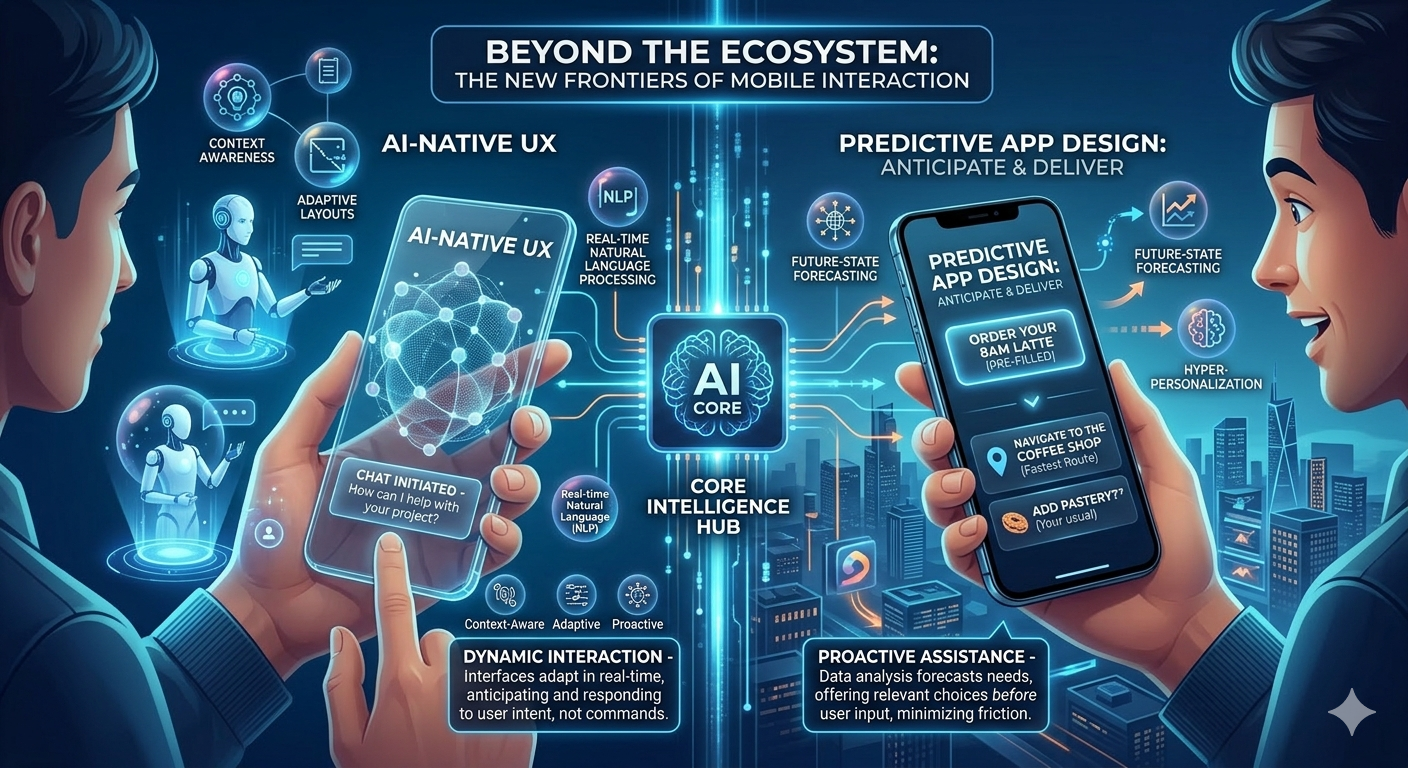
For anyone looking to visual the difference between this and traditional apps, the provided image illustrates the vast difference. On the left side, “Multi-Platform Ecosystems” emphasizes seamless integration and continuity across devices like laptops, tablets, phones, watches, and smart speakers. In contrast, the right side shows “Standalone Mobile Apps” with isolated functionality and localized data, requiring users to actively manage their experience. This image perfectly sets the stage for our discussion: AI-Native UX and predictive design are what bridge that gap, making the individual, isolated experience feel as smooth and integrated as an entire ecosystem.
What is AI-Native UX?
AI-Native UX means building user interfaces around and with artificial intelligence from the ground up. It’s not a feature tacked onto an existing interface; it’s the core philosophy driving interaction. These interfaces are designed to adapt, learn, and personalise the user journey.
The Power of Predictive App Design
Predictive app design is the outcome of AI-Native UX. It leverages machine learning algorithms to analyze vast amounts of user data (in compliance with privacy regulations, of course!) to anticipate future needs, behaviors, and preferences.
Why Does This Matter?
The shift towards AI-Native and Predictive UX offers significant benefits for both users and app developers:
For Users:
Reduced Friction: Fewer taps, searches, and clicks mean an effortless experience.
Hyper-Personalization: The app truly “gets” them, making it more valuable and enjoyable.
Increased Efficiency: Tasks are completed faster, saving valuable time.
Improved Guidance: The app can guide users towards optimal paths or prevent errors based on past behavior.
For Developers & Businesses:
Higher Engagement & Retention: Personalized, effortless experiences build loyalty.
Increased Conversion Rates: Anticipating needs and offering relevant suggestions boosts sales.
Enhanced Brand Differentiation: Offering cutting-edge, predictive UX sets you apart from competitors.
Improved Operational Efficiency: Automated tasks and predictive insights can optimize resources.
The Road Ahead: Overcoming Challenges
While the potential is vast, integrating AI-Native UX poses unique challenges:
Privacy and Trust: Transparency and ethical data usage are crucial. Users must trust that their data is handled responsibly and that AI isn’t manipulate.
Complexity & Resources: Building and training sophisticated AI models requires expertise and significant computational resources.
Handling Ambiguity: AI models can make errors. Designing interfaces that gracefully handle cases where the AI’s prediction is incorrect is essential (e.g., providing easy fallback options).
Avoiding “Creepiness”: Balancing personalization with respecting user boundaries is delicate. The experience should feel supportive, not invasive.
Designing the Future, One Prediction at a Time
AI-Native UX and Predictive App Design represent the future of human-computer interaction. It’s not just about adding features; it’s about fundamentally rethinking how technology serves and anticipates our needs. For app developers, embracing this shift is no longer a luxury but a necessity for building truly successful and user-centric applications in an increasingly competitive digital landscape.